
Does your brain currently feel like an internet browser running with thirty-seven tabs open?
- Three tabs are playing music, and you don’t know where the sound is coming from.
- Four tabs are frozen and buffering.
- Twelve tabs are articles you swore you would read three weeks ago.
- And your memory keeps shouting: "Remember to buy oat milk! Did you reply to Dan? Pay estimated taxes! What was that podcast idea?"
Relying on your biological memory to hold errands, ideas, reminders, and logistics is a recipe for chronic cognitive exhaustion.
Your brain evolved to generate ideas and solve complex problems, not to serve as an unorganized storage locker for grocery items and dental appointments. When your working memory is overloaded with mundane logistics, you experience brain fog, decision fatigue, and creative paralysis.
In Chapter 11 of Productivity Micro-Habits: Tiny Changes, Big Impact, author Grace Keys reveals the life-changing solution: The Frictionless Second Brain Micro-Habit.
Prefer to watch? Here's the 2-minute version:
What is a Second Brain (and Why Most Systems Fail)?
A "Second Brain" is simply an external, reliable capture system outside of your head where you store thoughts, tasks, and creative insights.
Most people fail when building a second brain because they fall into the Over-Engineering Trap:
- They download complex, multi-layered database software.
- They spend three days building color-coded relational databases, tag hierarchies, and automated linking templates.
- Within two weeks, the system requires so much maintenance that updating it feels like a second full-time job. They abandon it, and their mental clutter returns.
Grace Keys’ core doctrine is radically simple: Friction Kills Consistency.
A second brain only works if capturing a thought takes less than 10 seconds and requires zero friction.
The 3 Zero-Friction Capture Formats
Pick ONE capture tool based on your natural lifestyle. Do not use all three.
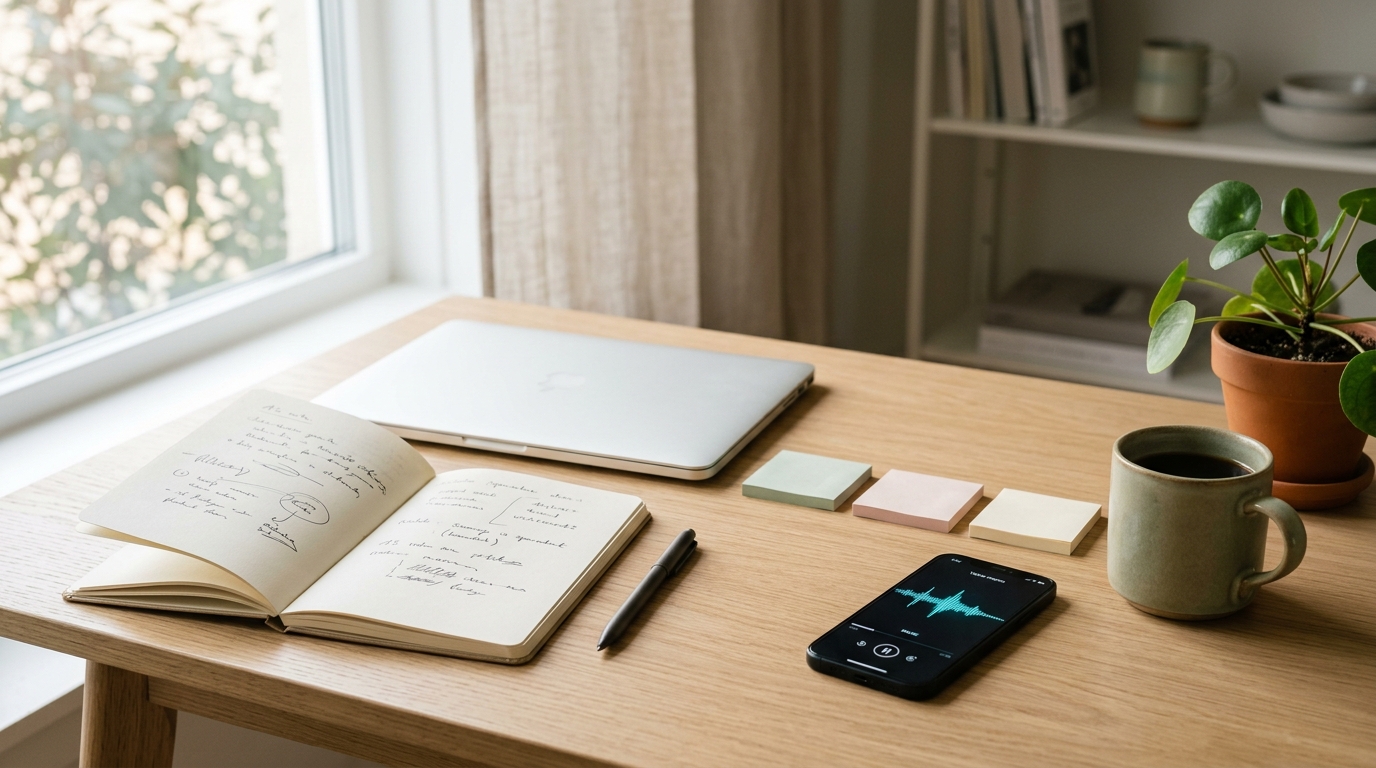
1. The Analog Minimalist (The Desk Notebook)
- Setup: Keep a single, small unlined notebook open flat beside your keyboard at all times, titled "BRAIN DUMP".
- Execution: Whenever an errant thought strikes—a book recommendation, an errand, a worry—jot it down immediately in a single sentence. Do not organize, do not format, do not categorize. Just dump the thought and return to your deep work.
2. The Digital Nomad (The Single Pinned Note)
- Setup: Open your phone’s default notes app (Apple Notes, Google Keep, or Notion). Create a single note titled "INBOX: CAPTURE" and pin it to the top of your screen or home screen widget.
- Execution: One tap to open, type the thought, close the app. Zero folder selection.
3. The Hands-Free Commuter (The 10-Second Voice Memo)
- Setup: Use your phone’s voice recorder or smart assistant.
- Execution: Walking the dog or driving in traffic? Hit record: "Remember to check printer ink, idea for Q4 webinar." You capture the spark before it evaporates, without touching a keyboard.
Anchoring Your Second Brain into Daily Rhythms
A capture system is only as good as its integration into your established daily anchors. Grace Keys connects the second brain to three natural transition points:
Notice what happens when you institute this routine: your biological brain learns that thoughts placed on the page are safe. Because your brain trusts the system, it stops obsessively looping reminders in the middle of the night.
Case Study: The Scattered Freelance Strategist
Grace Keys shares the experience of Marcus, a freelance marketing strategist juggling five separate client retainers.
Marcus was drowning in mental tabs. He kept ideas scattered across Slack drafts, email flags, paper napkins, and Apple Notes. He lived in constant terror that he was dropping a critical ball, leaving him exhausted and anxious.
Guided by Chapter 11 of Productivity Micro-Habits, Marcus stripped away the complexity and adopted Grace Keys' Single-Pad Rule:
- He placed one 5x7 spiral notepad directly under his monitor.
- For two weeks, every fleeting to-do, client idea, and personal errand went onto that single pad.
- At 5:00 PM each day, he spent four minutes reviewing the list: crossing off completed items, and migrating true deadlines to his master calendar.
The result? Marcus reported a 40% reduction in daily anxiety within seven days. His focus sharpened, his billable output increased, and for the first time in two years, he was able to completely disconnect on weekends.
Key Takeaways
- Working Memory Is Limited: Your brain is engineered to generate solutions, not store infinite task lists.
- Eliminate Capture Friction: Avoid complex databases; choose a single system where recording a thought takes under ten seconds.
- Choose Your Weapon: Stick to one primary tool—the Open Desk Notebook, Pinned Mobile Note, or Voice Memo.
- Anchor to Daily Transitions: Tie your second brain reviews to morning coffee, meeting exits, and evening shutdowns.
- Trust Frees Bandwidth: When your brain trusts that ideas are safely recorded, mental tabs close and creative flow returns.
Master Frictionless Productivity Systems
Ready to eliminate digital chaos, build sustainable daily routines, and master time management? Get Grace Keys' complete productivity framework:
📖 Featured Book: Productivity Micro-Habits: Tiny Changes, Big Impact by Grace Keys
🌐 Discover the Total Mindset Mastery Series: Total Mindset Mastery Series
💬 What is your current system for capturing stray ideas—organized or pure chaos? Let us know below!
We'd Love to Hear From You
"Which insight or framework in this guide resonated with you most? Share your thoughts below!"
Share your feedback or questions with Grace KeysProductivity Micro-Habits: Tiny Changes, Big Impact
By Grace Keys • URMS Publishing
This practical framework was pulled from Productivity Micro-Habits: Tiny Changes, Big Impact by Grace Keys. Discover proven cognitive tools, actionable worksheets, and transformative habits.
Never Miss an Insight
Join our VIP Reader Team for weekly frameworks and book giveaways.
Subscribe Free