Congratulations! You have checked your credit score, spoken with a mortgage specialist, established your pre-qualified budget, and officially decided to embark on one of life’s most exciting adventures: finding your next home sweet home.
Whether this is your very first purchase or your fifth upgrade, the search process is filled with exhilarating possibilities.
You open real estate apps and see thousands of listings: sun-drenched breakfast nooks, sprawling fenced-in backyards, gleaming quartz kitchen islands, and exposed brick lofts.
Within two weeks of touring properties on weekends, however, a strange feeling sets in: House-Hunting Fatigue.
Every home starts to blur together. One property has an incredible primary suite but a terrifying basement. Another sits in your dream neighborhood but lacks an extra bedroom for your home office. A third has brand-new stainless appliances, but the morning commute would add forty-five minutes of gridlock to your daily life.
You and your partner start arguing in the car over whether a two-car garage is a "must-have" or a "nice-to-have." You feel overwhelmed, confused, and terrified of making a costly mistake.
In Chapter 2 of Home Sweet Home: A Step-by-Step Guide for First Time Home Buyers, real estate veteran Sally Street offers a calming, structured compass:
"House hunting without a clear framework is like walking into a grocery store starving without a shopping list—you end up exhausted, distracted by shiny packaging, and spending way more than you planned. Finding the right home isn't about chasing perfection; it's about matching your unique lifestyle, budget, and future goals to the right property."
Here is Sally Street’s battle-tested, 6-step roadmap to navigating the home-hunting adventure with total confidence.
Step 1: Your Timeline Anchor (How Long Will You Stay?)
Before you fall in love with a front porch or a spa-like master bathroom, ask yourself the most fundamental strategic question:
"How long do I realistically plan to live in this home?"
The Timeline Decision Matrix
Starter Home
Prioritize Resale Liquidity: Buy in high-demand school districts or vibrant urban hubs where homes sell quickly.
Mid-Term Home
Prioritize Adaptability: Extra bedroom for family growth or remote work; flexible floor plan that evolves.
"Forever" Home
Prioritize Neighborhood Stability: Long-term layout quality, accessibility, lot privacy, and community peace.
Pro Tip: Because real estate involves transaction fees (agent commissions, transfer taxes, title policies, and closing costs), planning to stay for at least three to five years generally ensures that appreciation and equity paydown outpace your closing expenses.
Step 2: Bedroom & Square Footage Realities (Your Space Budget)
Square footage is not merely a number on an MLS sheet; it is your personal space budget.
Many first-time buyers fall into the "Bigger is Always Better" trap. They tour a 3,200-square-foot house with four formal living zones, fall in love with the grandeur, and forget the operational reality:
- Higher square footage means higher monthly heating and cooling bills.
- More rooms require thousands of dollars in additional furniture.
- Larger homes mean spending your entire Saturday cleaning empty rooms and vacuuming hallways.
The Bedroom Audit:
Ask yourself:
- How many people live here today?
- Do we plan to expand our family or adopt pets in the next 36 months?
- Do I work remotely full-time? (A dedicated, quiet home office with a closing door is vastly superior to working from a kitchen island).
- How often do guests realistically visit? (If out-of-town guests visit twice a year, consider a fold-out sofa or Murphy bed in an office rather than paying $300/month in extra mortgage interest for a dedicated, empty guest room).
Step 3: Sorting Needs from Wants (Jake’s Case Study)
In Chapter 2 of Home Sweet Home, Sally Street shares the illuminating story of Jake, a single marketing manager who decided to buy his first property.
When Jake began his search, he gave his real estate agent a lengthy "Must-Have" list:
- Two bedrooms, two baths
- A rooftop balcony with skyline views
- A commercial-grade fitness center in the building
- High-end quartz countertops and custom European cabinetry
- Located within five minutes of his downtown office
When Jake began touring condos that checked every single box, he was shocked: they were $85,000 over his approved budget.
Discouraged and frustrated, Jake sat down with his agent and completed Sally Street’s Needs vs. Wants Exercise:
Non-Negotiable Needs (Deal-Breakers)
- Under $290,000 total purchase price
- Safe neighborhood with low crime rates
- Dedicated quiet space for remote work
- Reasonable monthly HOA dues (< $250)
- Within 25-minute commute to office
Nice-to-Have Wants (Flexible Wishes)
- Rooftop balcony or private terrace
- High-end quartz countertops
- In-building fitness center
- Designer light fixtures
- Hardwood floors throughout
The Revelation:
Jake realized that the gym in his rental building was something he only used twice a month—he preferred jogging outside in city parks. He realized that countertops and light fixtures were easily upgraded down the road for a few thousand dollars.
By stripping away non-essential "wants," Jake found a charming, quiet two-bedroom condominium in a historic brick building twelve minutes from his office. It was priced $15,000 below his budget ceiling. He used the savings to install his own quartz countertops six months later.
Step 4: The 40-Minute Radius Mapping Method
Where your home sits is infinitely more important than the paint on the walls.
You can renovate a kitchen, paint an exterior, or knock down an interior partition wall. You cannot renovate your home’s location.
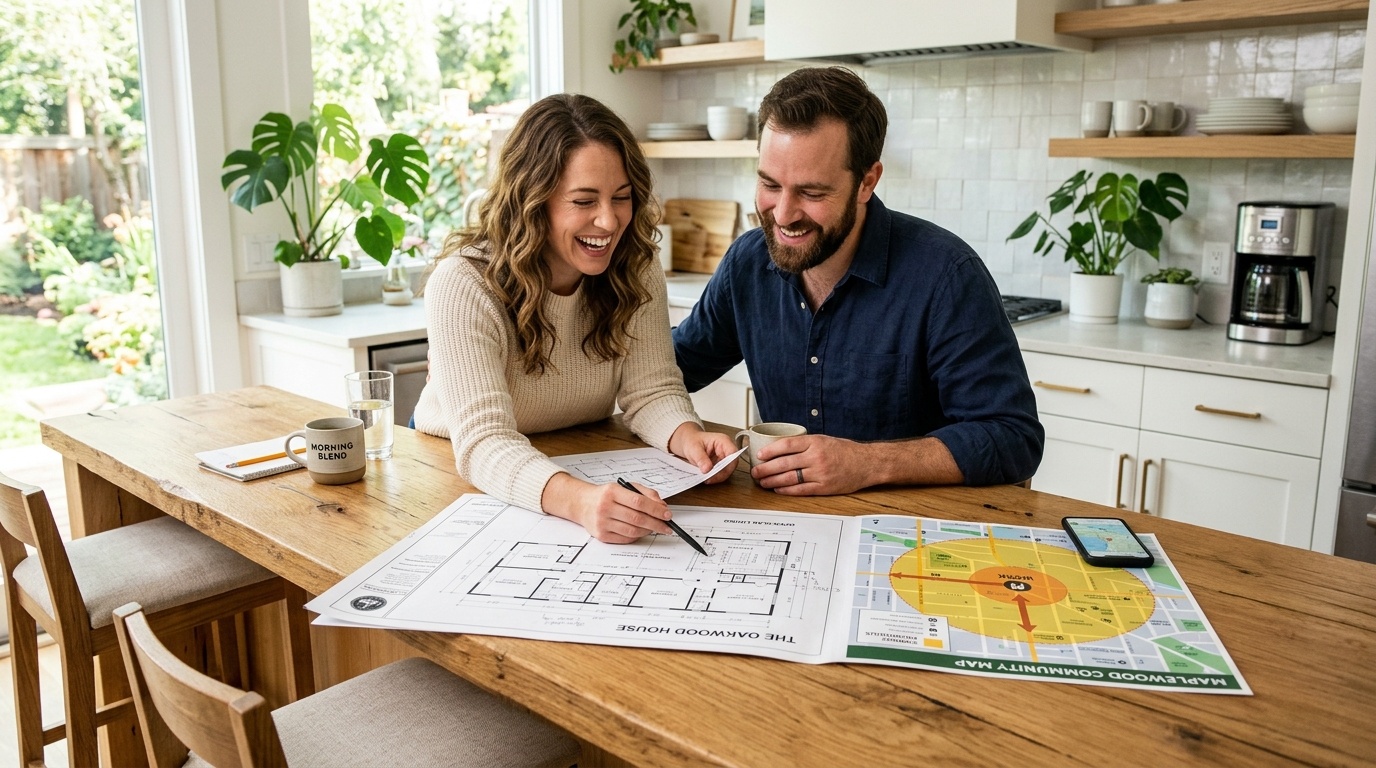
Sally Street introduces a brilliant visual tool: The 40-Minute Radius Map:
The 40-Minute Radius Commute Map
How to Build Your Search Radius:
- Identify Your 3 Anchor Points: Write down your three most critical weekly destinations (e.g., your workplace, your parents/childcare, and your favorite outdoor/social district).
- Draw Your Commute Perimeter: Determine your maximum acceptable travel time (e.g., 40 minutes during peak rush hour).
- The Rush-Hour Test Drive: Never buy a home without driving the route on a Tuesday morning at 7:45 AM and a Thursday evening at 5:30 PM. A picturesque country road that takes 20 minutes on a Sunday afternoon can easily morph into a 65-minute bumper-to-bumper nightmare on a rainy weekday.
- The Neighbor Vibe Check: Sally Street recommends walking the neighborhood on a Friday evening. Stop and introduce yourself to someone watering their lawn or walking a dog. Ask: "We're thinking about buying down the street—what do you love about living here, and what drives you crazy?" Their honest answer is worth more than ten real estate brochures.
Step 5: Matching 11 Property Types to Your Lifestyle
Not all homes are created equal. Chapter 2 breaks down eleven distinct property types so you can choose the right operational fit:
| Property Type | Best Suited For | Key Trade-Off / Consideration |
|---|---|---|
| Condo / Townhouse | Busy professionals, travelers seeking "lock-and-leave" | Less privacy, shared walls, monthly HOA fees |
| Duplex / Triplex | First-time buyers interested in "house-hacking" | Becoming a landlord, managing tenants next door |
| Single-Family Pre-Owned | Growing families, pet owners wanting private yards | Responsible for 100% of exterior maintenance |
| Ranch / One-Level | Buyers wanting zero stairs, aging-in-place | Smaller square footage footprint |
| Fixer-Upper | Handy buyers, DIY enthusiasts wanting sweat equity | Renovation fatigue, hidden plumbing/electrical costs |
| Brand-New Home | Buyers wanting move-in ready code & builder warranties | Higher purchase price, potential construction delays |
| Manufactured Home | Budget-conscious buyers wanting extreme affordability | Land ownership considerations, slower appreciation |
| Tiny Home | Minimalists, eco-conscious buyers, downsizers | Zoning restrictions, highly limited storage |
| Custom-Built Home | Buyers wanting 100% control over architectural layout | High upfront capital, complex 9–18 month build time |
| Multi-Family (4-Plex) | Aspiring real estate investors building wealth | Substantial down payment and property management |
| Cottage / Cabin | Remote workers, nature lovers, vacation retreats | Rural utility services (well, septic tank upkeep) |
Step 6: New vs. Used Homes: The Honest Pros & Cons
Should you buy a sparkling, newly constructed property, or a home with history and character?
In Chapter 2, Sally Street weighs the honest trade-offs:
Brand-New Homes
- • 100% move-in ready with zero immediate renovations
- • 10-year structural builder warranty protection
- • State-of-the-art modern energy codes & lower utility bills
- • Trade-off: Higher purchase price & smaller lot sizes
Pre-Owned (Used) Homes
- • Mature tree canopies, larger yards & landscaping
- • Unique architectural craftsmanship & character
- • Lower cost per square foot in established neighborhoods
- • Trade-off: Aging roofs, HVAC systems, & maintenance
The Truth About Warranties:
- New Homes: Almost always come with comprehensive Builder Warranties covering structural defects for up to 10 years, mechanical systems for 2 years, and cosmetic finishes for 1 year.
- Used Homes: Rarely have builder warranties, but you can negotiate a One-Year Home Warranty Policy paid by the seller as part of your purchase agreement. This policy covers repairs or replacement of refrigerators, furnaces, and plumbing fixtures during your first twelve months.
The Fixer-Upper Rule of Thumb:
If you are considering an older fixer-upper home, obtain contractor quotes before submitting an offer.
- Painting walls, replacing carpets, and swapping kitchen hardware are cheap, manageable weekend projects.
- Replacing a failing roof ($12,000), remediating foundation cracks ($18,000), or replumbing galvanized pipes ($10,000) will destroy your savings if you haven't budgeted for them in advance.
The Core Philosophy: "No Home Is Perfect"
As you tour properties, adopt Sally Street’s liberating mantra:
"No home is perfect. Every house on earth has quirks—a slightly dated bathroom, a squeaky second-floor stair, or a driveway that slopes. Don’t look for flawless perfection. Look for solid structural bones, an incredible location, and a space that has the potential to become your dream home over time."
Your First-Time Home-Hunting Action Checklist
Take this checklist with you to every property tour:
Key Takeaways
- Anchor Your Timeline: Know how many years you plan to stay before filtering listings.
- Prioritize Real Space Over Excess Rooms: Choose a square footage layout that serves your daily lifestyle, not empty guest rooms you clean twice a year.
- Master Needs vs. Wants: Emulate Jake’s case study. Strip away cosmetic luxury features and focus on non-negotiable structural and budget deal-breakers.
- Use the 40-Minute Radius Tool: Map your commute, test drive during morning rush hour, and chat with prospective neighbors.
- Evaluate Property Types Honestly: Balance the low-maintenance perks of townhomes against the autonomy and privacy of single-family homes.
- Embrace Quirks Over Perfection: Focus on location, layout, and structural health; cosmetic updates can be completed gradually over time.
We'd Love to Know
"What is your #1 non-negotiable deal-breaker in a home? Tell us in the comments below!"
Share your thoughts or questions with the authorHome Sweet Home: A Step-by-Step Guide for First Time Home Buyers
By Sally Street • URMS Publishing
This house-hunting playbook was adapted from Home Sweet Home by Sally Street. Avoid costly buyer mistakes, separate needs from wants, and conquer the market stress-free.
Never Miss an Insight
Join the VIP Reader Team for weekly frameworks and book giveaways.
Subscribe Free