The Habit Stacking Formula: Piggybacking on Existing Brain Waves
How many times have you sat down at your desk with great intentions, only to find yourself 45 minutes later with 27 browser tabs open, scrolling through social media, and feeling completely scattered?
In today's hyper-connected world, willpower is a finite resource. Expecting yourself to generate focus out of thin air is a recipe for frustration.
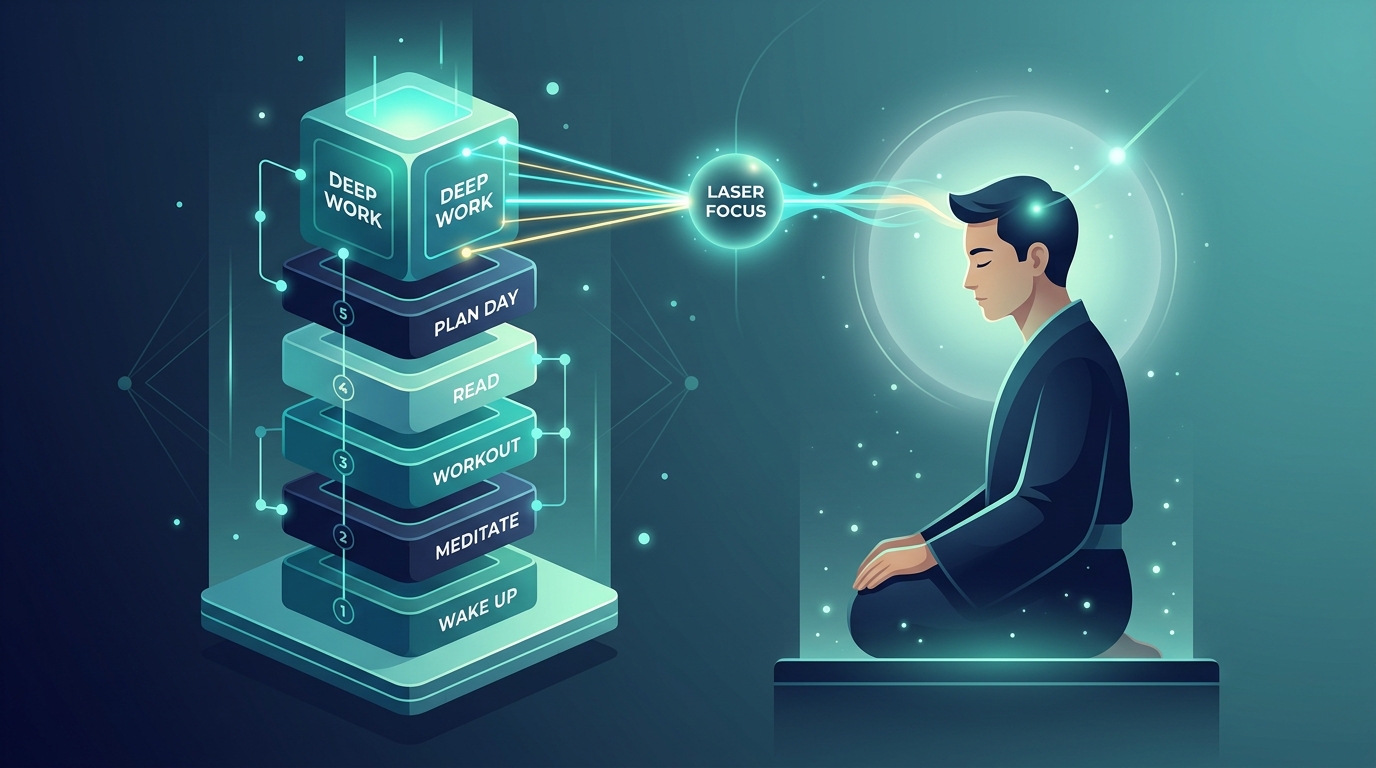
In Chapters 3 & 4 of Productivity Micro-Habits, author Grace Keys introduces two game-changing strategies: Habit Stacking and Focus Anchoring. Together, these tools allow you to piggyback new positive routines onto existing neural pathways and initiate laser-sharp attention in under 30 seconds.
Universal Habit Stacking Formula
Real-Life Habit Stack Examples:
- Morning Focus Stack: "After I open my laptop, I will close all browser tabs except the one needed for my primary task."
- Physical Energy Stack: "After I pour my morning coffee, I will drink 1 full glass of room-temperature water."
- Mindfulness Stack: "After I put my car in park at work, I will take 3 deep, slow breaths before opening the door."
The "Start Line" Habit: Triggering Deep Focus in 30 Seconds
One of the biggest productivity killers is transition friction—the mental dread of switching from relaxation to intense work. Grace Keys introduces the 30-Second Start Line Habit to eliminate transition anxiety.
Clear the Stage
Hide your phone in another room or flip it face down on your desk.
Set a 2-Minute Timer
Tell yourself you only have to work on your primary task for 120 seconds.
Execute the First Micro-Action
Type 1 sentence, open the project file, or outline 1 bullet point.
Pro Tip:
Once you break the friction of starting, momentum takes over. 85% of people who start a task for 2 minutes naturally continue working for 30 minutes or more.
3 Micro-Habits to Shield Your Focus from Distractions
| Focus Micro-Habit | Execution Time | Impact on Attention |
|---|---|---|
| Tab Purge | 10 seconds | Reduces cognitive load by eliminating visual clutter |
| Phone Out of Reach | 5 seconds | Removes physical temptation & dopamine checking loops |
| 1-Task Sticky Note | 20 seconds | Anchors working memory on one singular priority |
Frequently Asked Questions (FAQ)
What makes a good anchor habit for stacking?
A good anchor is something you do every single day without fail at a predictable time—such as pouring coffee, washing your hands, turning on your computer, or getting into bed.
How many habits can I stack at once?
Start with one micro-habit per anchor. Once that stack feels 100% automatic (usually after 14–21 days), you can chain a second micro-habit onto it.
Master Deep Focus & Habit Anchoring
This insight was pulled from Productivity Micro-Habits: Tiny Changes, Big Impact by Grace Keys.
Explore The BooksNever Miss an Insight
Join the VIP Reader Team for weekly frameworks and book giveaways.
Subscribe Free